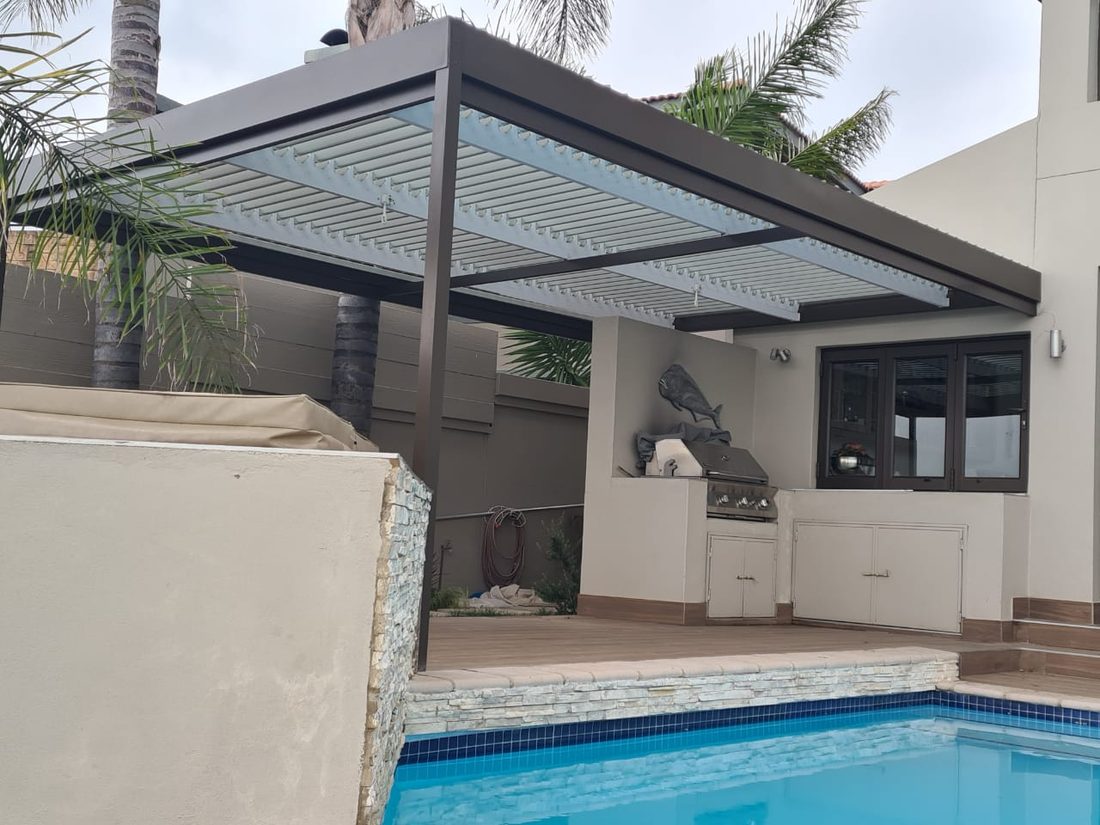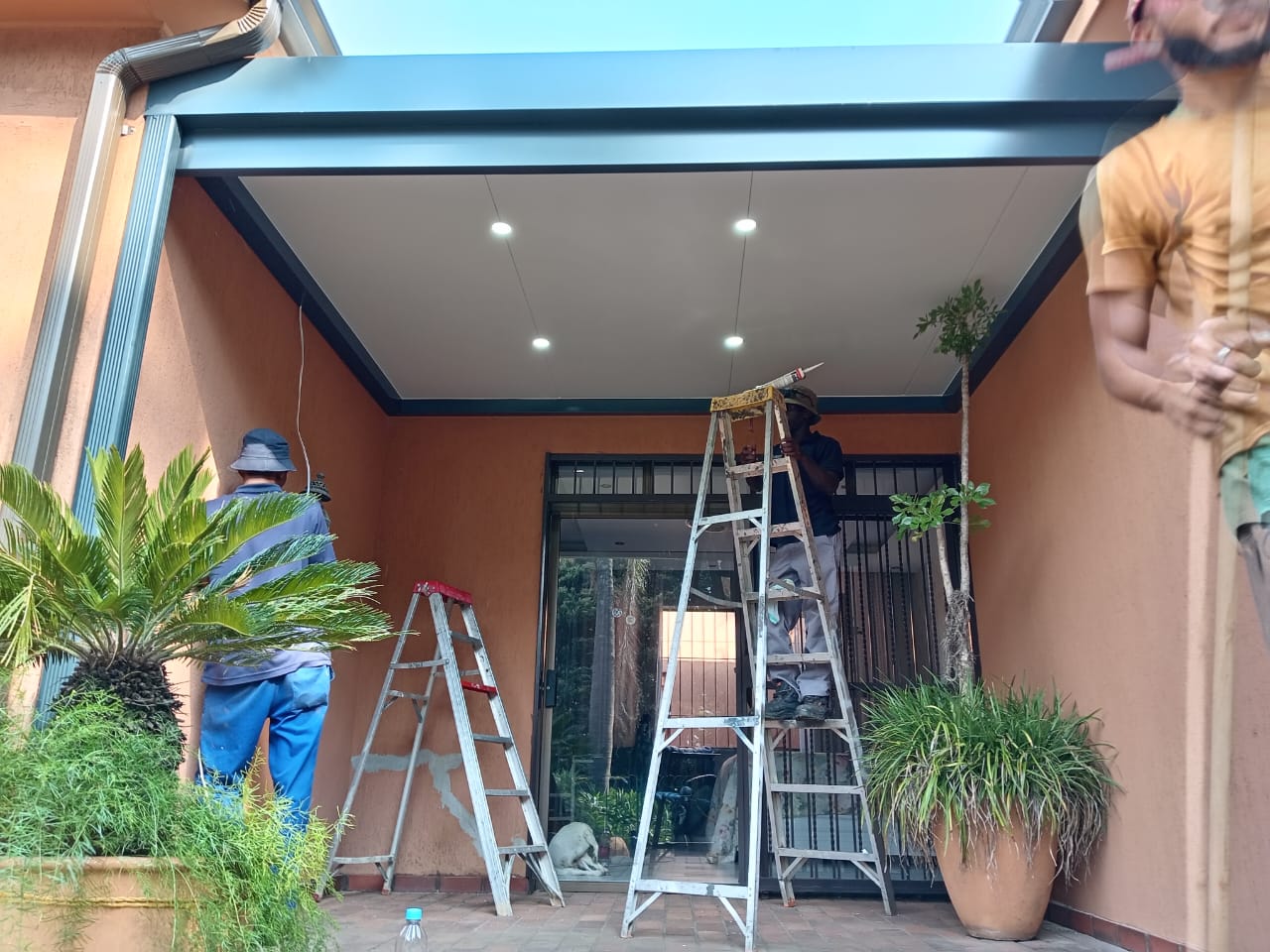

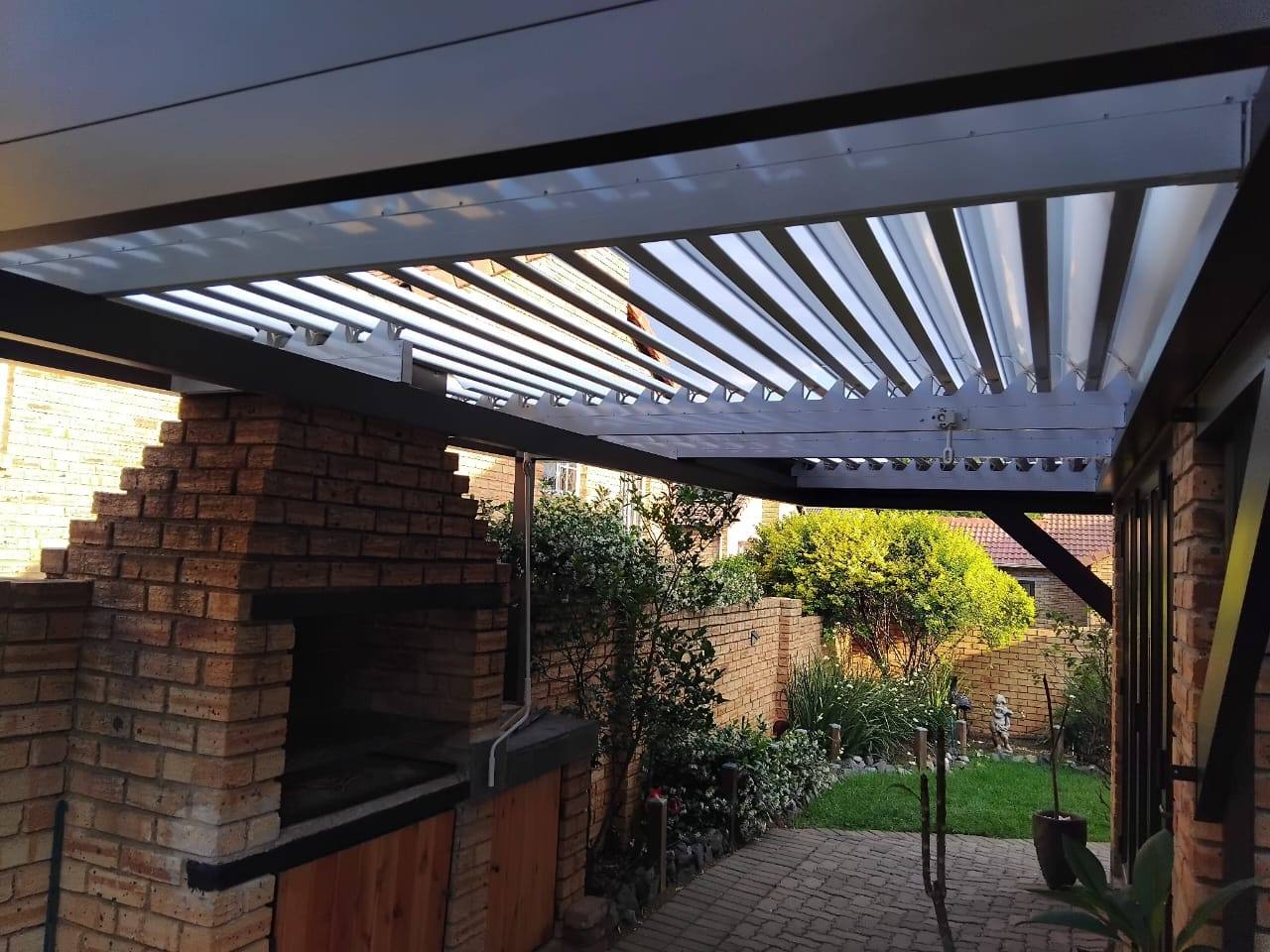
The short answer
Chromadek® is pre-painted steel: galvanised steel sheet with a thin factory paint system, made by ArcelorMittal South Africa. Powder-coated aluminium is a lighter metal that protects itself with an oxide film. Both are rated for inland use if installed and maintained properly. Patio Projex chose powder-coated aluminium and doesn't supply Chromadek®. That includes our fixed IBR awnings: aluminium sheets on an aluminium frame.
The rest of this page is the detail behind that paragraph. The Chromadek® facts come from its maker's own data sheets, the aluminium facts from the Aluminium Federation of South Africa and the weight comparison from AZoM. Every source is listed at the bottom so you can check them yourself.
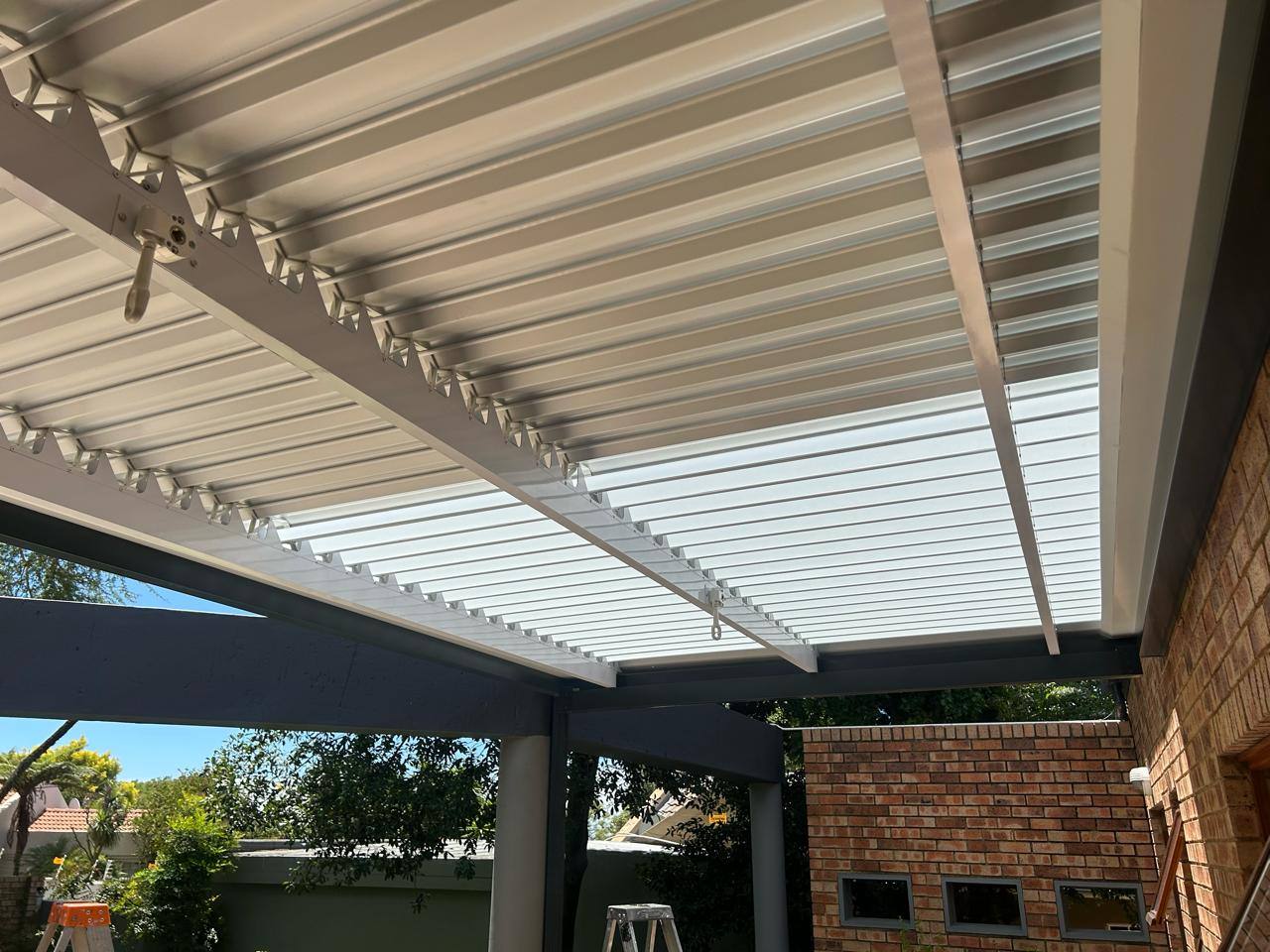
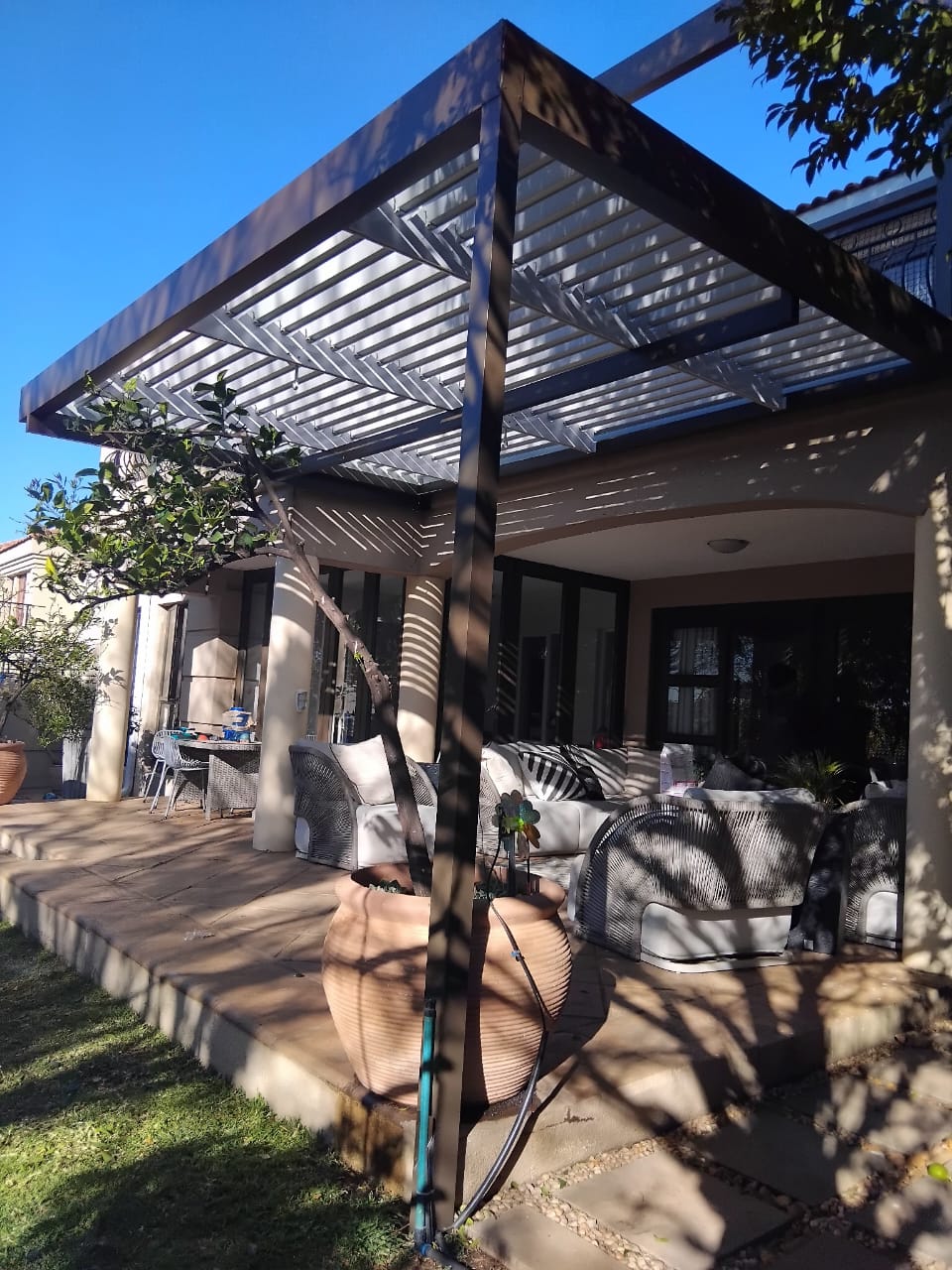
Louvre carriers, posts and blades on a Randpark Ridge job. On our louvre awnings these parts are powder-coated aluminium. See the job.
Thinking about your own patio?
Send a photo on WhatsApp or leave your number. We come back with options and a tailored quote.
What Chromadek® is
Chromadek® is ArcelorMittal South Africa's trade name for a range of colour-coated steel sheet used for roofing and cladding. The company says it has made it in South Africa for more than 35 years.1
Standard Chromadek® starts as Z200 hot-dip galvanised steel. Z200 means 200 g/m² of zinc in total across both faces of the sheet, roughly 14 µm a side.2 The top face gets a 5 µm primer and an 18 to 22 µm top coat. The reverse gets a single 8 µm backing coat. A heavier grade, Chromadek ULTIM®, uses Z275 steel and a thicker paint system and is meant for heavy industrial or marine sites.1
It has real strengths, and it would be unfair to leave them out. It carries a maker's warranty (on the conditions set out below) and is rated Class A1 for reaction to fire. The maker also says its cut edges are not prone to corrosion, because the zinc protects the exposed steel, and that light scratches from installation can generally be left alone for the same reason.1
The same data sheet is just as clear about the care it needs:1
- The maker says thin pre-painted coats are more sensitive to scratches and corrosion than thick coatings.
- If blisters, or corrosion creeping along a scratch, show up, it advises prompt repainting.
- Edge corrosion where sheets overlap or end will spread unless it is cleaned and repainted in good time.
- Steel filings left on the roof after cutting will rust and tarnish the paint, so they have to be brushed off as the work goes.
- It recommends an inspection twice a year, washing off the dirt that rain doesn't remove.
- Standard Chromadek® is not recommended within 5 km of the sea's high-water mark, and is normally excluded from warranty there.
- In marine and heavy industrial areas, the underside of canopy-type roofs can corrode faster, because rain doesn't wash it and the underside coating gives less protection. The maker's remedies are regular washing with clean water, a light ceiling underneath, or a fuller paint coat on the reverse side.
What powder-coated aluminium is
Aluminium protects itself with a hard, inert oxide film that forms in air and re-forms straight away whenever the metal is cut or scratched.3 Powder coating adds the colour and a second layer of protection. In the factory, charged powder is sprayed onto the aluminium, then the parts go through an oven at 180 to 200 °C, where the powder melts into a continuous film. A single architectural coat is 60 to 80 µm thick.3
The finish is graded by durability. Standard polyester powder coat to SANS 1796 (equivalent to Qualicoat Class 1) has a life expectancy of 10 to 15 years and suits corrosivity areas C1 to C4. Super-durable polyester, Qualicoat Class 2, is rated for 15 to 25 years.3
Aluminium has its limits too, and the Aluminium Federation says so plainly:3
- Powder coat is not abrasion resistant, and a factory finish can't be brought back to its original properties by touching it up on site.
- Localised pitting will eventually occur. It can look untidy, but it isn't structurally significant.
- It still needs washing with a mild neutral detergent. The Federation's finishes table says every three to six months; its care guide says six to twelve months inland and about three months at the coast. No wire brushes, steel wool or abrasive pads.
- It shouldn't sit in direct contact with copper or brass that can get wet.
On our louvre awnings, the louvre carriers, posts and blades are powder-coated aluminium, and those are the parts our 15-year guarantee covers against rust, paint chipping and corrosion. The guarantee asks for regular cleaning and maintenance.
Side by side
The aluminium column gives the Aluminium Federation's figures for certified architectural powder coat. Ask any supplier, us included, which standard their coater works to.
| Pre-painted steel (Chromadek®) | Powder-coated aluminium | |
|---|---|---|
| Base metal | Steel sheet with a zinc coating (Z200 on the standard grade)1 | Aluminium3 |
| What stops corrosion | Paint as a barrier, over zinc that also protects exposed steel at cuts1 | The metal's own oxide film, which re-forms when cut or scratched, under the powder coat3 |
| Coating thickness | Paint: top face at least 23 µm including primer, underside a single 8 µm backing coat, over about 14 µm of zinc a side (the maker quotes 40 µm in total)12 | 60 to 80 µm for a single powder coat3 |
| Scratches | Light scratches can usually be left; blisters or rust creep along a scratch need prompt repainting1 | The metal re-forms its oxide film, but the coat isn't abrasion resistant and can't be restored to factory condition on site3 |
| Edges and joints | Cut edges protected by the zinc; edge corrosion at overlaps and sheet ends spreads unless treated1 | Keep away from wet copper or brass; crevice corrosion is avoided by good detailing3 |
| Near the sea | Standard grade not recommended within 5 km of the high-water mark; ULTIM® grade to 400 m1 | Standard powder coat rated for C1 to C4; C5 sites need an extra coat or pre-treatment3 |
| Inland figures | Maker's warranty: 10 years weathering and non-peeling, 20 years to perforation, in C1 to C31 | Life expectancy of the coat: 10 to 15 years (standard) or 15 to 25 years (super-durable). The metal keeps its strength, though pitting eventually occurs3 |
| Weight | Steel is about three times as dense as aluminium4 | About 2.7 g/cm³, around a third of steel. This compares the metals, not finished awnings4 |
| Maintenance | Inspect twice a year; wash with clean water and a soft brush; clear cutting filings and loose fasteners1 | Wash with a mild neutral detergent: every 3 to 6 months in AFSA's finishes table, 6 to 12 months inland in its care guide; no abrasive pads3 |
| Warranty terms | Maker's warranty valid only if formally issued on a detailed written request; excludes damage during profiling, transport, storage or after installation1 | Depends on the supplier. Ours: 15 years on the aluminium louvre carriers, posts and blades, against rust, paint chipping and corrosion, with regular cleaning a condition |
What this means in Gauteng
Start with the honest part. Gauteng isn't coastal, so the 5 km rule doesn't apply here. The Aluminium Federation's corrosion map puts the Highveld's rural and suburban areas in category C3.3 In C3, ArcelorMittal's warranty table gives standard Chromadek® 10 years against weathering and peeling, and 20 years to perforation.1 For most Johannesburg suburbs, then, genuine Chromadek® that is installed and maintained the way its maker specifies is inside its rating.
Industrial pockets are different. The same map puts high-traffic urban areas and sites close to heavy industry in C4, and names the East Rand and parts of Pretoria.3 ArcelorMittal's table groups C4 and C5 under "Marine/Heavy Industrial" and marks standard Chromadek® there as either not recommended (unless the manufacturer agrees) or not guaranteed.1 Standard powder coat on aluminium is rated up to C4.3 If you live near heavy industry, ask any supplier which category their product is rated for.
One claim you'll hear that we won't make: that aluminium runs cooler. Colour makes a measurable difference under a metal roof, and ArcelorMittal says heat-reflective pigments can cool a dark Chromadek® roof by up to 8 °C.1 If heat is your main worry, look at an insulated patio ceiling rather than at the metal.
So why aluminium for us? Three reasons, each one you can check:
- Protection starts with the metal itself. Its oxide film re-forms at every cut and scratch.3
- For the same volume, aluminium weighs about a third of what steel does.4
- Our 15-year guarantee on the aluminium louvre carriers, posts and blades, against rust, paint chipping and corrosion.
None of that makes Chromadek® a bad product. It is a different material with different care needs, and we'd rather you choose knowing both. To see how we put the aluminium to work, read how our adjustable louvre awnings are built, or browse every awning type we make.
Before you sign any awning quote
- Ask what each part is made of and get it in writing on the quote: frame and posts, gutter, fascia, and the roof sheet or blades. Some adverts put "Chromadek" and "aluminium" in the same line, so go part by part.
- If a sheet is sold as Chromadek®, look at its reverse side. ArcelorMittal brands genuine Chromadek® there, about 140 mm in from the edge of the flat coil and roughly every 900 mm along it, before the sheet is profiled.1
- Ask who holds the warranty. Chromadek's maker says no warranty is valid unless it has formally issued one in response to a detailed written request, so ask whether the installer will make that request for you.1
- For aluminium, ask which parts the guarantee covers and what cleaning it requires. Ours covers the louvre carriers, posts and blades, and asks for regular cleaning without solvents or ammonia-based cleaners.
- If your home is near heavy industry, ask which corrosion category the product is rated for.
Want it priced in aluminium? Send a photo of the space with rough width, projection and height (our measurement guide shows how) on WhatsApp or through the full quote form, or leave your number in the quick form below.